
Biochemistry Notes are very important for nursing students to understand how our body gets energy from food. In Semester 1, the most important topic is Carbohydrates, which are the primary source of energy for humans. Understanding the chemical basis of life helps nurses manage patient diets and metabolic disorders.
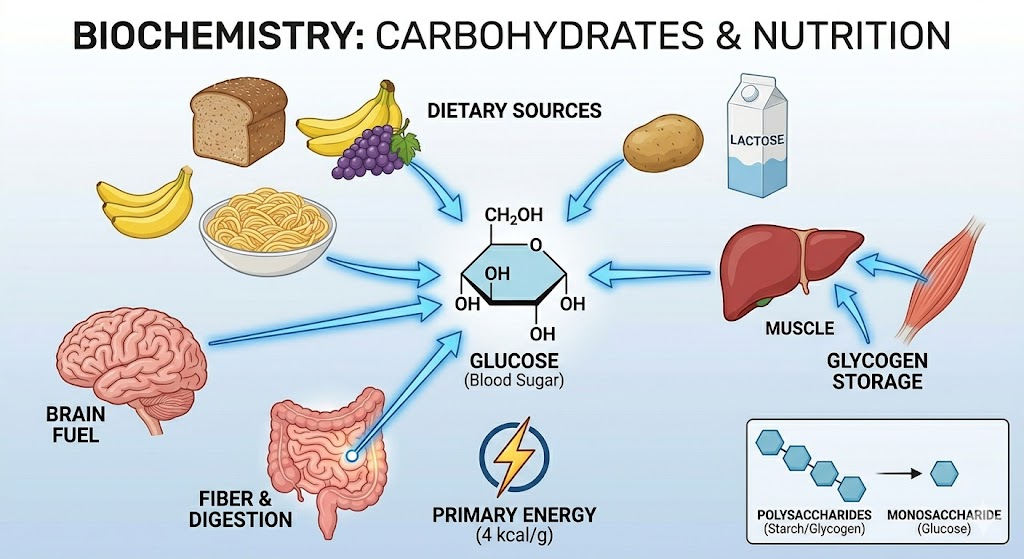
What are Carbohydrates?
Carbohydrates are organic compounds made of Carbon, Hydrogen, and Oxygen $(C_n(H_2O)_n)$. In simple words, they are “Sugars” and “Starches” that provide fuel to our cells. They are the most abundant biomolecules on Earth. For a nursing student, knowing the difference between a simple sugar and a complex starch is vital for patient education.
7 Key Functions of Carbohydrates
Why do nurses need to study carbohydrates? Here are 7 reasons why they are essential:
-
Primary Energy Source: They provide 4 kcal of energy per gram. This is the quickest way for the body to get power.
-
Brain Fuel: The brain depends mostly on glucose (a simple carb) for energy. Without enough glucose, a patient might feel dizzy or confused.
-
Protein Sparing Action: If we eat enough carbs, the body doesn’t need to burn protein for energy. This allows protein to do its main job: tissue repair.
-
Fat Metabolism: Carbs are needed to burn fats properly. Without carbs, the body produces “ketones,” which can be dangerous in high amounts.
-
Digestive Health (Fiber): Some complex carbs (fiber) cannot be digested but help in moving food through the gut and preventing constipation.
-
Structural Component: Carbohydrates help in building cell membranes and are parts of DNA and RNA (Ribose sugar).
-
Energy Storage: Extra glucose is stored as Glycogen in the liver and muscles for future use.
Detailed Classification of Carbohydrates
In these Biochemistry Notes, we classify carbohydrates based on how many sugar units they have:
1. Monosaccharides (Single Sugars)
These are the simplest form of carbs and cannot be broken down further.
-
Glucose: The main sugar in our blood.
-
Fructose: Found in fruits and honey.
-
Galactose: Found in milk products.
2. Disaccharides (Double Sugars)
These are made of two monosaccharides joined together.
-
Sucrose (Table Sugar): Glucose + Fructose.
-
Lactose (Milk Sugar): Glucose + Galactose.
-
Maltose: Glucose + Glucose.
3. Polysaccharides (Complex Carbs)
These are long chains of hundreds of sugar units. They take longer to digest and provide steady energy.
-
Starch: Found in potatoes, rice, and wheat.
-
Glycogen: Animal starch stored in our muscles.
-
Cellulose: Found in plant walls (fiber).
Clinical Importance for Nurses (The “Why”)
Nurses must apply biochemistry in real-life hospital settings:
-
Diabetes Management: Nurses monitor blood glucose levels. High glucose (Hyperglycemia) or low glucose (Hypoglycemia) can be life-threatening.
-
IV Fluids: We often give patients 5% Dextrose (which is glucose) through an IV when they cannot eat.
-
Lactose Intolerance: Some patients cannot digest milk sugar (Lactose), causing stomach pain. Nurses help them choose “Lactose-free” diets.
How Carbohydrates are Digested
The digestion of carbohydrates begins in the Mouth with an enzyme called Salivary Amylase. It then moves to the small intestine where it is broken down into simple glucose. The glucose is then absorbed into the bloodstream, where the hormone Insulin helps it enter our cells for energy.
Practice Quiz: Biochemistry (Carbohydrates)
Test your knowledge with these 10 MCQs:
Q1: What is the primary function of Carbohydrates in the human body?
A) Building muscles B) Providing energy C) Storing genetic info D) Protecting bones
Q2: How much energy does 1 gram of carbohydrate provide?
A) 9 kcal B) 7 kcal C) 4 kcal D) 2 kcal
Q3: Which sugar is known as “Blood Sugar”?
A) Fructose B) Glucose C) Lactose D) Sucrose
Q4: Which of the following is a “Complex Carbohydrate”?
A) Glucose B) Starch C) Fructose ) Galactose
Q5: Milk sugar is scientifically called:
A) Sucrose B) Maltose C) Lactose D) Glucose
Q6: Extra glucose is stored in the liver as:
A) Fat B) Protein C) Glycogen D) Cellulose
Q7: Which organ depends almost entirely on glucose for energy?
A) Heart B) Liver C) Brain D) Kidneys
Q8: Sucrose (Table Sugar) is made of Glucose and:
A) Galactose B) Fructose C) Glucose D) Lactose
Q9: Which process describes the breakdown of glucose to produce energy?
A) Photosynthesis B) Glycolysis C) Osmosis D) Diffusion
Q10: “Fiber” is a type of carbohydrate that helps in:
A) Vision B) Digestion C) Hearing D) Muscle growth
Answer Key
-
B | 2. C | 3. B | 4. B | 5. C | 6. C | 7. C | 8. B | 9. B | 10. B
Go back to Generic BSN Year 1 for more subjects
click here .https://nurseprepify.com/category/generic-bsn/year-1/